
How Photographers Can Overcome Growth Challenges and Scale Their Business
Guest article by Virginia Cooper
For professional photographers running a studio or solo operation, photography business growth often brings a frustrating ceiling: more demand, but not enough time, systems, or confidence to meet it. The core tension in scaling a photography business is that what worked to get booked can start breaking as volume increases, creating business growth challenges that feel personal but are mostly structural. Common sticking points show up fast, capacity limits, inconsistent lead flow, pricing pressure, uneven client experience, and anxiety around photography market expansion. Naming these pain points clearly makes it easier to choose the right kind of next move and scale with control.
Next-Step Levers: Marketing, Partnerships, Offers, and Hiring
When you hit the “stuck” stage, too many plates spinning, inconsistent leads, and fear of hiring, growth gets easier when you pick a few levers and pull them on purpose. Use the ideas below as a menu, choosing the 2–3 that match your biggest bottleneck right now.
Run a 14-day client acquisition sprint: Pick one primary channel (referrals, local search, social, or email) and one offer, then do the same actions daily for two weeks so you can measure what’s working. Example: 20 minutes/day commenting on local venue posts + 5 direct messages/day to warm leads + 2 portfolio posts/week with a clear call-to-action. This helps when you’re anxious about marketing because you stop “trying everything” and start learning from repeatable data.
Build one “signature offer” and two add-ons: Make your core package easy to buy: one clear outcome, a simple price ladder, and a defined process. Then add two profitable add-ons (extra coverage hour, album design, commercial usage licensing, short-form video add-on) to lift average order value without doubling your workload. This works well when your pain point is pricing pressure or burnout, your calendar stays similar, but revenue per job increases.
Diversify with a low-lift service line: Choose one adjacent service that reuses your skills and gear and can be delivered in batches (headshots days, product photography mini-sessions, team lifestyle shoots, quarterly brand refresh sessions). Start with a pilot: 5 paid bookings in 30 days, a repeatable shot list, and a tight turnaround promise. This is especially useful when your market feels saturated or seasonal and you need more stable cash flow.
Create strategic partnerships in photography with a “swap” pitch: Identify 10 businesses that already serve your ideal clients, venues, planners, salons, gyms, realtors, coworking spaces, and propose a simple co-promotion. Offer one free image set for their marketing or a staff headshot day in exchange for being their preferred referral, a brochure spot, or inclusion in their welcome email. Partnerships work best when you want warmer leads without paying for ads.
Delegate your marketing before you delegate your craft: If editing and client work are maxing you out, offload the tasks that keep leads consistent, website updates, email follow-ups, basic content planning, lead tracking. A marketing professional can help you show up consistently online while you protect shooting time, which directly addresses the “I can’t market and deliver” capacity crunch. Start with a 30-day scope: refresh your top 3 pages, set up 3 automated inquiry replies, and publish 6 portfolio posts.
Hire for one role, one metric, one season: Instead of “I need a team,” define the smallest hire that removes your biggest bottleneck, assistant for setup/teardown, editor for turnaround speed, associate shooter for overflow. Decide the success metric upfront (deliver galleries in 7 days, take 30% of admin off your plate, book 4 extra sessions/month) and test it for 8–12 weeks. This makes hiring photographers and staffing your photography business feel less risky because the role has boundaries, expectations, and a clear win condition.
Build Hiring Confidence With Simple HR Systems (and Training)
As your marketing and offers start working, the next growth pain point is often people, finding help, setting expectations, and leading well. If you want to sharpen those business skills in a structured way, going back to school can be a practical move. An HR degree, for example, can teach you how to recruit and manage employees, shape a healthy company culture, administer benefits, and set clear policies, skills that make hiring feel less like guesswork and more like a repeatable part of running your studio. One concrete option is a bachelor's in human resources online to build that foundation as you scale. With stronger people-management confidence, whether from school or experience, you can sequence your next growth moves without trying to do everything at once.
Plan → Test → Package → Measure → Refine
To keep your next growth moves simple, use this rhythm. It turns big ideas like market research and new offers into a sequence you can repeat monthly, so you are not guessing what to do next. It also helps you separate growth from scaling, since scaling involves expanding operations in a way your team and systems can actually support.
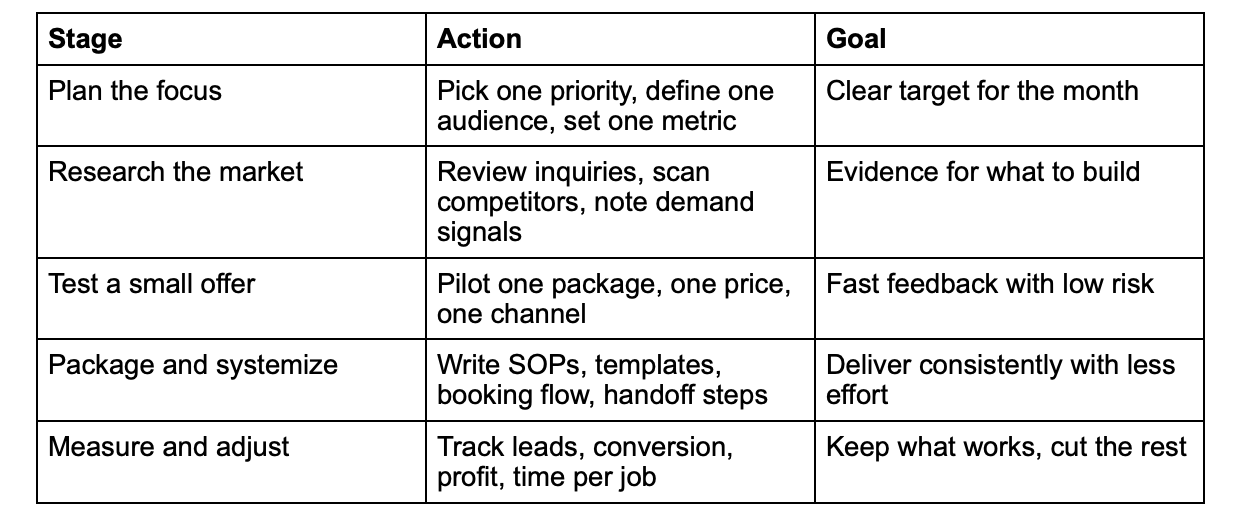
Each phase informs the next: research guides the test, the test reveals what to systemize, and measurement tells you what to refine. Because many companies fail to scale, repeating a tight loop can keep your studio from expanding faster than your foundation.
Scaling Your Photography Business: Common Questions
Q: How do I raise prices without losing bookings?
A: Increase pricing in small steps and pair it with a clear reason clients can feel, like faster turnaround, a better album, or a smoother planning process. Test the new rate with one package first, then review your inquiry-to-booking rate for 2 to 4 weeks. If bookings dip, adjust the offer before you adjust your confidence.
Q: When should I hire help instead of “pushing through”?
A: Hire when editing, emails, or admin work consistently blocks you from selling and shooting. Many owners are in the same phase, and hiring within the next six months is common among growing small businesses. Start with a contractor for one task and set a weekly budget cap.
Q: What if I cannot find reliable contractors or employees?
A: Hiring is hard right now, and filling open positions is a real capacity constraint for many organizations. Make the role smaller, more specific, and easier to succeed in with a checklist and sample files. Run a paid trial project before you commit long term.
Q: How can I enter a new market without burning time and money?
A: Pick one niche, one message, and one channel for 30 days, then evaluate results. Offer a limited pilot package to generate real conversations and a few portfolio examples. Only expand once the demand is consistent.
Q: Should I add new services or focus on one core offer?
A: If delivery feels chaotic, focus on one core offer and make it repeatable first. Add services only when your workflow, templates, and turnaround can handle the extra complexity. One strong signature package often scales better than five “maybe” options.
Build Scaling Confidence With One Weekly Business Growth Move
Growth can feel stuck when creative work is strong but decisions around pricing, marketing, and capacity keep triggering second-guessing. The way through is a steady, confidence-first approach: clarify what “better” looks like, make aligned choices, and keep applying growth strategies with simple checkpoints. When that mindset guides next steps for photographers, momentum replaces overwhelm and scaling confidence becomes practical, not personal. Pick one move, measure it, and repeat.